Meditation Research: What the Brain Studies and the Evidence Show
Meditation research is the branch of the field most reported and least carefully read. This entry covers what the brain studies actually measure, which findings are robust, and where the interpretation typically outruns the data.
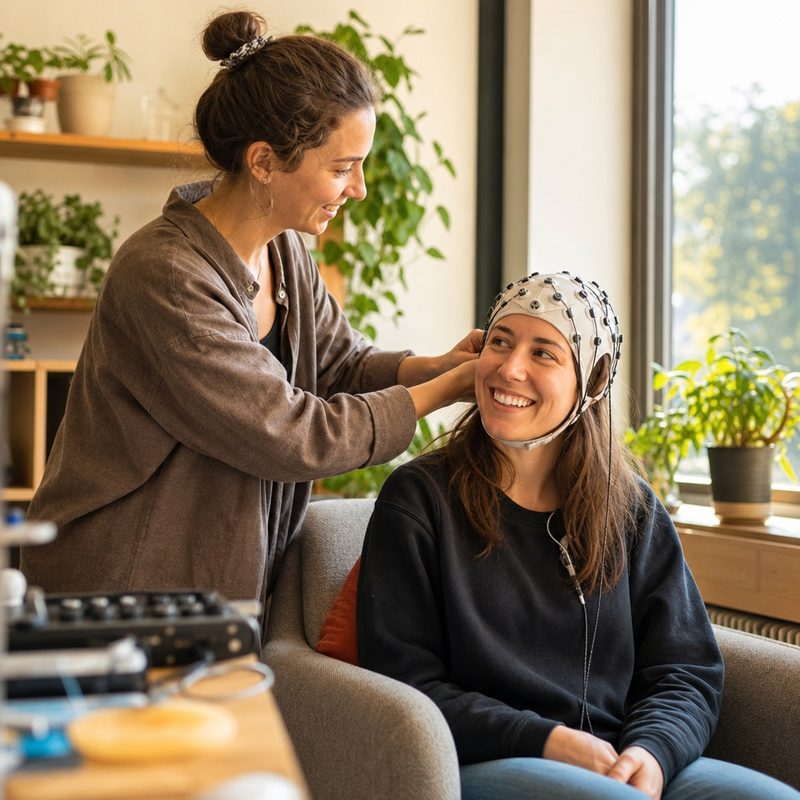
Meditation research studies form a wider field than the clinical work on eight-week programmes. It asks a different question: not whether a course helps patients, but what sustained attentional training does to attention itself, and whether that is visible in the brain and body.
The distinction matters because the two literatures are constantly mixed together. A finding about long-term practitioners is not evidence about a beginner, and a clinical outcome in a pain trial is not a neuroscientific result.
What Meditation Research Measures in the Brain
Meditation and the brain research divides into three designs, and most confusion comes from treating them as one.
| Design | What it compares | Main limitation |
|---|---|---|
| Cross-sectional | Experienced practitioners against non-meditators | Cannot separate practice from the traits of people who pursue it |
| Longitudinal | The same beginners before and after a course | Small samples; effects measured immediately after |
| State studies | The brain during meditation against during rest | Says nothing about durable change |
Almost all meditation and the brain research falls into one of these three, and nearly every over-claim in popular coverage comes from reading a cross-sectional result as a longitudinal one: reporting that meditation thickened a region when the study established only that practitioners and non-practitioners differ.
Findings That Hold Up Reasonably Well
Two lines of work are consistent enough to take seriously. The first concerns the default mode network, the regions more active during mind-wandering and self-referential thought than during focused tasks. Reduced activity and altered connectivity in it are reported repeatedly across groups and designs, and the finding fits the practice: training attention away from self-narration should show up in the network associated with self-narration.
The second concerns responses to unpleasant stimulation. Experienced practitioners show altered patterns in how sensory intensity and emotional appraisal separate, which maps onto what participants describe in pain programmes. It also fits the clinical finding that pain interference changes more than pain intensity.
The structural work, including the frequently cited 2011 grey-matter study from Sara Lazar's group at Massachusetts General Hospital, is the most widely reported and the weakest in the sense that matters clinically. The measurements are real. What is missing is a link between a structural difference and any outcome a person would notice.
Where the Evidence Runs Out
Attention is the clearest case of a plausible claim outrunning its evidence. Meditation trains attention, so improved attention should follow. Laboratory tasks sometimes show it. The Goyal review nonetheless graded evidence for attention as insufficient, because task performance and durable everyday attention are not the same measure and the trials that would connect them largely do not exist.
Dose is the other open question. Effects are reported from eight-week protocols with roughly forty-five minutes of daily practice, and from long-term practitioners with thousands of hours. Between those two points there is very little, so the minimum effective dose is unknown, and shorter app-based formats are being deployed without knowing whether they clear it.
The Practices Being Studied Are Not One Thing
Meditation research studies pool practices that differ substantially in what they ask a person to do, which weakens any conclusion drawn across them.
- Focused attention. Attention held on a single object, returned when it drifts. The practice most beginners are taught first.
- Open monitoring. Attention held wide, noticing whatever arises without selecting. What the later weeks of an eight-week course move toward.
- Loving-kindness and compassion practice. Deliberate cultivation of a stance toward oneself and others. Studied largely for effects on social emotion rather than attention.
- Mantra-based practice. Repetition of a sound or phrase, including transcendental meditation, which has its own separate literature.
These produce different findings, and reviews that treat meditation as a single intervention are averaging across genuinely different activities. When a summary says meditation does something, the useful first question is which practice, in whom, for how long.
What Would Settle the Open Questions
The field's unresolved questions are tractable rather than mysterious, and most would yield to better-resourced studies of a familiar kind.
A dose-response study would establish the minimum practice producing measurable effects, which would immediately tell us whether shortened and app-based formats are plausible. Longitudinal work following beginners for years rather than weeks would separate durable change from the end-of-course peak that most trials capture. And larger imaging samples with pre-registered analyses would establish which structural findings survive, since several prominent ones rest on samples small enough that the honest position is that they are unreplicated.
Physiological Measures Beyond Imaging
Brain imaging attracts the attention, but a good deal of meditation research uses cheaper and often more interpretable physiological measures: heart-rate variability, cortisol, blood pressure, and inflammatory markers.
These have the advantage of connecting to outcomes anyone can recognise, and the disadvantage of being noisy. Cortisol varies with time of day, sleep, caffeine and the stress of being measured. Inflammatory markers respond to a great many things unrelated to whether someone meditated. Studies that control tightly for these tend to report smaller effects than studies that do not, which is the usual direction.
Heart-rate variability is the measure with the most coherent story, since it plausibly indexes autonomic flexibility and the practice plausibly affects it. Even there, effect sizes are modest and the literature is not large.
The Expectancy Problem
Meditation cannot be blinded. A participant always knows whether they have spent eight weeks meditating, which means every trial in this field carries an expectancy effect that cannot be separated from the intervention.
This is not unique to meditation; it applies to exercise and to psychotherapy equally. It does limit what any single trial can establish, and it is the strongest argument for active controls, since a comparison group that also receives a plausible-sounding programme at least holds expectation roughly constant.
Studies that attempt to manipulate expectation directly, by varying how a practice is described while keeping it identical, generally find that the description moves the result. That is a finding about human beings rather than about meditation, and it belongs in any careful reading of this literature.
Reading a Meditation Study
Three questions separate a sound study from a widely shared one.
- Cross-sectional or longitudinal? If practitioners are compared with non-practitioners, no causal claim is available.
- How many participants? Neuroimaging samples are frequently under thirty, which makes small effects unstable.
- Was there an active control, or a comparison against doing nothing?
Meditation research studies that answer all three well are a minority of what gets published and an even smaller minority of what gets reported.